

If you’ve ever sat in a meeting where half the room couldn’t hear the speaker, you already know why audio matters more than video in most spaces. People forgive a soft picture. They don’t forgive not understanding the person talking.
Biamp is one of the most widely specified names in professional audio for offices, schools, and healthcare and government facilities. The product lines overlap, so here’s a plain-English guide to what each one does and where it fits from an official installer, Infinity Technologies.
The Biamp building blocks
Tesira: the audio brain
Tesira is Biamp’s networked digital signal processing platform. Think of it as the central brain that takes audio from microphones, laptops, and conferencing systems, cleans it up, mixes it, and sends it to the right speakers. It scales from a single room to a campus-wide system, which is why it’s common in larger and multi-room installations.
Parlé: microphones and conferencing bars
Parlé is Biamp’s line of beamtracking microphones, available in ceiling, table, and pendant styles. They follow the direction of speech and adjust pickup in real time, so participants can move around without losing clarity. Parlé also includes all-in-one conferencing bars for small and medium rooms.
Devio: simplified conference room audio
Devio is built for meeting spaces where you want fewer boxes and faster setup. The Devio SCX models are conference room signal processors, with the SCX 400 supporting up to four Parlé microphones and the SCX 800 supporting up to eight. Both include five network ports, four of them PoE+ powered. av
Desono, Vocia, and Cambridge
Biamp’s wider portfolio also covers ceiling and surface loudspeakers (Desono), networked paging and voice evacuation (Vocia), and sound masking (Cambridge), which matters in open offices and healthcare spaces where speech privacy is a concern.
What’s new in 2026
Biamp has been busy, and a few updates are worth knowing about if you’re planning a project.
Parlé Voice Lift. Introduced with Tesira 5.6, it pairs Parlé microphones with Tesira DSPs so voices carry clearly in classrooms, training rooms, and lecture halls without handheld, lavalier, or podium microphones. It also won a Best of Show award at InfoComm 2026. For schools and training facilities, this removes a lot of the “who has the mic?” friction.
Devio UCX. Biamp’s first product built on the Microsoft Device Ecosystem Platform combines UC compute and professional-grade DSP in a single device, running Microsoft Teams Rooms on Android natively. For Teams-centered offices, that means one device doing the work of several.
BMA 360D ceiling microphone. A beamforming ceiling microphone designed to work with Tesira DSP systems over Dante. A good fit when you want a clean, unobtrusive look.
Platform certifications. TesiraFORTÉ X and Devio SCX room bundles are Cisco Certified, and the Parlé VBC 2800 is certified for Microsoft Teams Rooms. Certification matters because it means the audio has been validated with the platform your team already uses.
Biamp Workplace. A monitoring and control platform that won an ISE 2026 Best of Show award in the Installation category. For IT teams, this means seeing the health of rooms across a building (or multiple buildings) from one place.
Biamp updates its lineup frequently. Infinity Technologies will confirm current specs and availability before you finalize a design.
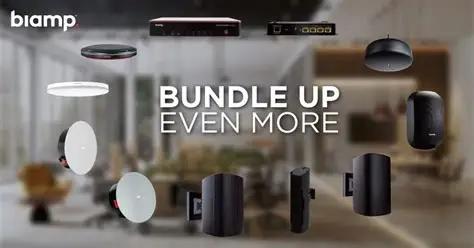
Which Biamp setup fits which space?
| Space | Typical approach |
|---|---|
| Huddle room (2–6 people) | All-in-one Parlé conferencing bar, or a Devio-based setup |
| Standard conference room | Devio SCX with Parlé microphones and ceiling speakers |
| Large boardroom or divisible room | Tesira DSP with multiple Parlé microphones and zoned speakers |
| Classroom or training room | Parlé Voice Lift with Tesira |
| Teams-first office | Devio UCX |
| Multi-room or campus facility | Tesira with Biamp Workplace for monitoring |
| Open office | Cambridge sound masking, plus paging where needed |
This is a starting point. Room size, ceiling height, acoustics, and how people actually use the space all change the right answer.
Why professional installation matters
Biamp hardware is high quality, but even the best equipment performs badly when it’s installed poorly. A professional installation covers:
- Room assessment. Dimensions, ceiling type, noise sources, glass and hard surfaces, and how the room is used.
- System design. Microphone and speaker placement, coverage zones, and signal flow, planned before anything is mounted.
- Network planning. Biamp systems live on your network, so VLANs, PoE capacity, and switch configuration matter. This is where having an IT provider and AV installer under one roof pays off.
- Clean installation. Properly terminated cabling, tidy racks, labeled connections, and ceiling work that looks finished.
- Tuning and commissioning. Biamp’s automated tools speed this up, but a technician still needs to verify results by ear in the actual room.
- Testing with your platform. Joining a real Teams, Zoom, or Webex call, not just playing test tones.
- Training and documentation. Staff should know how to use the room, and IT should have a record of how it’s configured.
Common mistakes we see
- Choosing equipment before assessing the room
- Ignoring acoustics. Glass, tile, and bare walls can defeat good microphones.
- Treating AV as separate from the network. Underpowered switches and missing VLANs cause intermittent problems.
- Skipping the real-world call test
- No monitoring. Without it, you find out a room is broken when someone is about to present.
- Overbuilding small rooms and underbuilding big ones
FAQ
Do I need Tesira, or is Devio enough?
For most standard conference rooms, Devio is simpler and faster. Tesira makes sense when you need more flexibility, many rooms, or larger, more complex systems.
Will Biamp work with Microsoft Teams, Zoom, and Cisco?
Biamp has certified solutions across Teams Rooms, Zoom Rooms, and Cisco. Compatibility depends on the specific model, so check certification for the exact products in your design.
How long does an installation take?
A single conference room is often a day or two on site once equipment is on hand. Larger or multi-room projects take longer. A site walk-through gives an accurate estimate.
Can you retrofit an existing room?
Often, yes. We’ll assess what can be reused and what needs to change.
Who supports it after installation?
That should be settled before the project starts. We offer ongoing support so rooms keep working after the install crew leaves.
Planning an AV project in Chicagoland?
Infinity Technologies designs and installs audiovisual systems for businesses, schools, and healthcare facilities across Chicagoland and Northwest Indiana, and we handle the network side too. Tell us about your space, and we’ll provide you a comprehensive plan.